Higher Storage Density, Increased Throughput, Smart Integration: Framo Morat Develops Satellite Vehicle Drive System for Automated Warehouse Application
Retailers are under increasing pressure: As customers expect ever-shorter delivery times and high product availability, demands on space efficiency and process speed in logistics and fulfillment operations continue to rise. Automated warehouse solutions — particularly those located close to large metropolitan areas — are gaining significant importance.
An innovative approach in this environment is the robotic inventory storage and retrieval system developed by a stealth robotics company preparing for its first commercial deployment. The system is designed to automatically store standardized totes within a highly dense storage structure, retrieve them precisely on demand, and deliver them to picking stations for order fulfillment.
A distinctive feature of the company’s solution is its ability to reach significant total storage heights — well beyond comparable systems. To maximize cubic space utilization, the focus extends beyond automation alone. The system is engineered to deliver high picking throughput within a compact footprint — a decisive factor for rapid retail fulfillment, enabling fast replenishment of stores, micro-fulfillment centers, and urban distribution hubs.
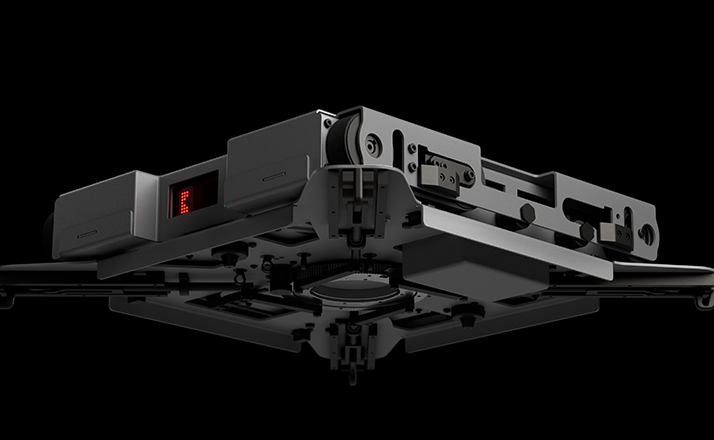
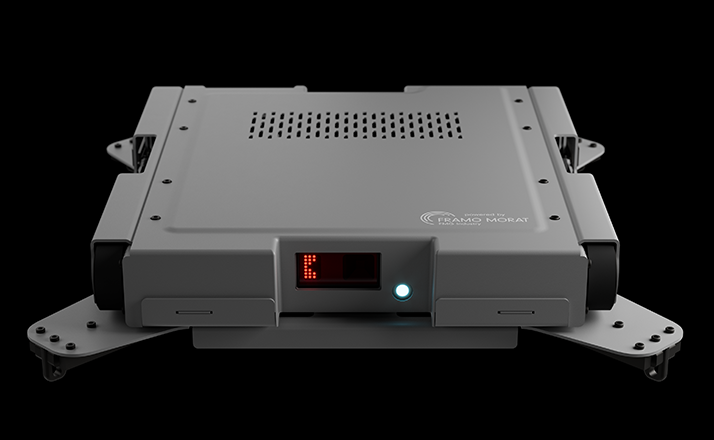
At the core of the concept is a combination of a rack structure, vertical shafts, and compact satellite vehicles that move totes horizontally within the storage grid. In simplified terms, the satellite vehicle travels into the storage lanes, precisely lifts a tote, transports it within the level of the system, and deposits it at the designated position.
A central component in this architecture is the garage, which handles the vertical transport of the satellite vehicles within the grid. The garage functions as a defined docking point, operational transfer station, and interface for power supply and system communication.
Starting Point: A Proven System — with Potential for the Next Evolution
In the first-generation system, which operated on a push-chain mechanism, the garage and satellite vehicle were mechanically integrated. While this approach enabled a fully functional solution, it imposed inherent limitations in terms of overall height, scalability, and maximum storage density.
With the development of the next generation, the company pursued a clear objective: The vehicle architecture needed to become significantly more compact, overall system dynamics had to increase, and total performance — particularly regarding targeted picking performance — had to be further improved.
To achieve this next stage of development, the company approached Framo Morat, a specialist in the development and manufacturing of customized drive solutions.
“After our initial joint brainstorming sessions, we quickly concluded that the satellite vehicle needed to operate independently from the garage”, recalls Wolfgang Sühling, Head of Advanced Engineering at Framo Morat.
This insight led to the concept of a satellite vehicle that is mechanically and electrically decoupled from the garage. This separation introduces new degrees of freedom in system layout, maintenance, scalability, and performance.
“The new system also operates far more flexibly and reliably in the event of a single satellite vehicle failure,” Sühling adds. “A disabled vehicle can be temporarily parked within the rack structure while the garage is relocated to another shaft.” This simplifies repair access while keeping the Garage — and therefore the overall system — fully operational.
Solution Concept: Satellite Vehicle with Fully Redesigned Gripper System
A key challenge was reducing the installation space — especially overall vehicle height — to increase storage density without compromising system dynamics. The vehicles must reliably maneuver totes through the storage grid. This results in demanding requirements for acceleration, repeatability, energy efficiency, and system robustness — particularly under continuous operation.
Drawing on decades of drive technology expertise and system-level competence, Framo Morat not only implemented the mechanical and electrical decoupling of garage and vehicle but also fundamentally redesigned the gripper system. Instead of the previously used four individual drives, the cam mechanism was optimized so that all grippers are now actuated by a single central drive.
This redesign reduces complexity, saves installation space, lowers component count, and increases overall system reliability. At the same time, it establishes the foundation for a more compact and service-friendly construction.
Customized Drive Technology: speeroX-Based Gearboxes for Compactness and Safety
The satellite vehicle is powered by a conventional motor-planetary gearbox combination. For movement within the shaft, the system utilizes a tracked drive system, ensuring robust traction and safe travel as it bridges distances between the garage and rack lanes. This configuration is critical to moving totes quickly, precisely, and repeatably — an essential prerequisite for achieving the targeted picking performance.
A particularly innovative element is the lifting and gripping mechanism responsible for tote elevation and placement. Two customized gear units based on Framo Morat’s proprietary speeroX gearing technology are used for this function. By implementing speeroX, the previously used worm gear could be replaced. Because speeroX enables identical output torque at a significantly smaller center distance, the vehicle height was substantially reduced — directly contributing to increased storage density across the system.
Additionally, the solution provides inherent self-locking functionality within the gearbox. This prevents uncontrolled lowering of a tote in the unlikely event of a system failure — an important safety and quality factor in automated warehouse environments.
From Gear Development to System Integration
At the beginning of the collaboration, Framo Morat’s scope focused primarily on gearbox development and motor selection. Over the course of the project, however, responsibilities increasingly expanded toward full system integration. In addition to motor control, sensor systems, energy distribution, conversion, and storage became central elements of the development.
The energy architecture represents a major difference between the first and second generation. While the cable-connected predecessor allowed many components to remain external, the new generation required extensive onboard integration — including PCBs, power electronics, and energy storage elements. Beyond mechanical integration, ensuring reliable communication between all onboard components was critical.
“The holistic design was proactively and innovatively conceived and realized by Framo Morat, while consistently meeting our electrical system requirements, such as communication protocols,” summarizes a spokesperson for the company.
Result: More Compact, More Powerful, Fully Integrated — and Ready to Scale
With the new satellite vehicle architecture and the comprehensive redesign of the drive and gripper mechanics, the foundation has been laid for a significantly more compact and higher-performance system generation. The combination of a robust travel drive, customized speeroX gearboxes for lifting, and an integrated electrical system architecture addresses the key requirements of modern fulfillment environments: high storage density, high system dynamics, and high process throughput — combined with reliable continuous operation.
The project exemplifies how Framo Morat contributes its core competencies — custom gearbox development, system design, and industrialization — to forward-looking robotics and intralogistics applications. From the initial concept to architectural development and integrated implementation, the collaboration with the company has created a powerful foundation for the next generation of robotic inventory storage and retrieval systems.
The satellite vehicle can already be seen at Framo Morat’s booths at the following upcoming trade shows:
LogiMAT, Stuttgart, Germany (March 24–26, 2026) | Hall 8, Booth 8C01 Schedule a tradeshow appointment here!
MODEX, Atlanta, GA, USA (April 13–16, 2026) | Hall A, Booth A1605 Schedule a tradeshow appointment here!